
1. Pram Radio, 1921
This pram provided with a radio was invented in 1921 including with antenna and loudspeaker, to keep the baby quiet, USA.

2. Yodel Meter, 1925
Back in 1925 Sally Blane and Betty Jewel try out the new yodel meter, which measures the pitch of the human voice.

3. Portable Radio in a Straw Hat, 1931
Portable radio in a straw hat, made by an American inventor, USA, 1931

4.Amphibious Bike, 1932
Amphibious Bike or Cyclomer invented in Paris, can ride with a load of 120 on land and water
 .
.
5. Max Factor’s Beauty Callibrator, 1934
This invented by Max Factor back in 1934. Max Factor demonstrates his “scientific device” the Beauty Micrometer which detects defects in feminine beauty that are imperceptible to the naked eye, 1934.

6. Baby Cage, 1937
Built in 1937 and distributed in London to members of the Chelsea Baby Club, the baby cage was meant for women with children but without a backyard, garden or terrace for them to play in or on.

7. Skating Baby Holder, 1937
Famous hockey player Jack Milford with the Wembley Monarchs decided that skating alone is not enough. So he invented a carrying device that would allow his wife and baby to join him on the ice.

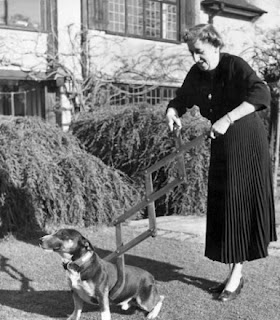
8. Dog Restrainer, 1940
This invented for restrainer the dog and who dont like to touch the dog lol...
9. Motorized Surfboard, 1948
Hollywood inventor Joe Gilpin riding his motorized surfboard. This man actually invented this motorized surfboard in the 1940s, we think it would have caught on if he had on some board shorts and took off the 3-piece suit. Or maybe this man can be credited with the birth of SUP? He is holding onto something, is that a paddle?. Not in production.

10. Venetian Blind Sunglasses, 1950
The Venetian Blind Sunglasses was a invented back in the 1950.

11. Curved Barrel Machine Gun, 1953
Invented in 1953, the M3 sub-machine gun has a curved barrel designed for shooting around corners. Curving the barrel is a good idea, but in practice the bullets tend to break up the curve after a few shots.

12. Rainy Day Cigarette Holder, 1954
This invented by President of Zeus Corp, Robert L. Stern, smoking a cigarette from his self-designed rainy day cigarette holder.

13. Cigarette Pack Holder, 1955
This invented for when smoking one cigarette is not enough.

14. Birdman Suit, 1955
This suit invented by Birdman Leo Valentin who killed him when his wings failed him after jumping out of an airplane in 1956.

15. Flying Platform, 1956
 Complementing Zimmerman’s "kinesthetic" theories, the Hiller Advanced Research Division (A.R.D.) incorporated a five foot fiberglass round wing, (ducted fan) with twin counter rotating coaxial propellers powered by two 44hp/4000 rpm, four cylinder opposed, two-cycle, Nelson H-59 Engines. The Nelson engine was the first two-cycle engine certified by the FAA for aircraft use. Utilizing the Bernoulli principle, 40% of the vehicle's lift was generated by air moving over the ducted fan's leading edge. The remaining 60% of lift was generated by thrust from the counter rotating propellers.
 Hiller Helicopters, on 17 September 1953 signed a contract with the Office of Naval Research's Naval Sciences Division (ONR) to incorporate Alexander Satin's ducted-fan research with Charles Zimmerman's "kinesthetic" theories. The classified project was turned over to the ARD at Hiller Aircraft, and construction began in January 1954. Nine months later the ARD group, working in complete secrecy, delivered the prototype model 1031 Flying Platform. The first free flight of the Flying Platform took place on 27 January 1955, and went in the record books as the first time man had flown a ducted fan vertical take off and landing (VTOL) aircraft. In April of 1955 the veil of secrecy was lifted and all the world wanted a vectored thrust vehicle for their own.
 Hiller Helicopters was awarded a U.S. Army contract in 1956 and produced two larger model flying platforms with the Army designation of VZ-1 Pawnee. These vehicles are similar in design but were 8 feet in diameter, 7 feet high, weighted 180lbs empty and the contract required a third Nelson engine installed. The added weight from the third engine severely affected the pilots' ability to use "kinesthetic" movements for directional control. A modified version of the Pawnee, with a longer duct skirt was designated the VZ-1E, and ended its career at Princeton University as a test vehicle for ducted fan research.
 Of the six Flying Platforms that were built, the (ONR) vehicle is on exhibit at the Hiller Aviation Museum, and the National Air & Space Museum has a VZ-1 Pawnee that is on loan to the Pima Air & Space Museum. Both platforms may be viewed on line at their respective web-sites. The location of the remaining flying Platforms are unknown. If you have information regarding the disposition or physical location of other Hiller platforms please contact the museum.
"This invention relates generally to ways and means for propelling a person through the air in a controlled flight. More particularly the invention provides a wingless aircraft propelled by thrust reaction and capable of vertical ascent for take off and climbing, hovering in the air, horizontal flight, and vertical descent under such conditions that directional control, and transition from vertical to horizontal flight and vice versa are effected by body movements or balance of the pilot flying the machine." (A statement from the Patent # 2,953,321)
The 47-year-old Hiller flying platform, the closest design to mimic a magic carpet still captures the public imagination.
16. Sea Shoes, 1962
The inventor M. W. Hulton demonstrates his sea-shoes and duckfoot propellers on the Grand Union Canal, England.

17. TV Glasses, 1963
The first set of TV glasses were invented by Hugo Gernsback in 1963. Hugo Gernsback was an Luxembourg American inventor, writer and magazine publisher, best remembered for the first science fiction magazine, Amazing Stories, first published in 1926. His contributions to the genre as publisher were so significant that, along with H.G. Wells and Jules Verne, he is sometimes popularly called “The Father of Science Fiction”.


This pram provided with a radio was invented in 1921 including with antenna and loudspeaker, to keep the baby quiet, USA.

2. Yodel Meter, 1925
Back in 1925 Sally Blane and Betty Jewel try out the new yodel meter, which measures the pitch of the human voice.

3. Portable Radio in a Straw Hat, 1931
Portable radio in a straw hat, made by an American inventor, USA, 1931

4.Amphibious Bike, 1932
Amphibious Bike or Cyclomer invented in Paris, can ride with a load of 120 on land and water

5. Max Factor’s Beauty Callibrator, 1934
This invented by Max Factor back in 1934. Max Factor demonstrates his “scientific device” the Beauty Micrometer which detects defects in feminine beauty that are imperceptible to the naked eye, 1934.

6. Baby Cage, 1937
Built in 1937 and distributed in London to members of the Chelsea Baby Club, the baby cage was meant for women with children but without a backyard, garden or terrace for them to play in or on.

7. Skating Baby Holder, 1937
Famous hockey player Jack Milford with the Wembley Monarchs decided that skating alone is not enough. So he invented a carrying device that would allow his wife and baby to join him on the ice.

8. Dog Restrainer, 1940
This invented for restrainer the dog and who dont like to touch the dog lol...

9. Motorized Surfboard, 1948
Hollywood inventor Joe Gilpin riding his motorized surfboard. This man actually invented this motorized surfboard in the 1940s, we think it would have caught on if he had on some board shorts and took off the 3-piece suit. Or maybe this man can be credited with the birth of SUP? He is holding onto something, is that a paddle?. Not in production.

10. Venetian Blind Sunglasses, 1950
The Venetian Blind Sunglasses was a invented back in the 1950.

11. Curved Barrel Machine Gun, 1953
Invented in 1953, the M3 sub-machine gun has a curved barrel designed for shooting around corners. Curving the barrel is a good idea, but in practice the bullets tend to break up the curve after a few shots.

12. Rainy Day Cigarette Holder, 1954
This invented by President of Zeus Corp, Robert L. Stern, smoking a cigarette from his self-designed rainy day cigarette holder.

13. Cigarette Pack Holder, 1955
This invented for when smoking one cigarette is not enough.

14. Birdman Suit, 1955
This suit invented by Birdman Leo Valentin who killed him when his wings failed him after jumping out of an airplane in 1956.

15. Flying Platform, 1956
The Hiller Aviation Museum houses some of the most unique flying machines imaginable. One such craft, the Flying Platform, is the prototype developed from National Advisory Committee for Aeronautics (N.A.C.A.) engineer Charles H. Zimmerman's concept known as the "Flying Shoes". Charles Zimmerman, to the amusement of his engineering peers, proved the theory that rotors on the top (i.e. helicopters) are inherently unstable. Zimmerman theorized a person's natural balancing reflexes would suffice in controlling a small flying machine. Charles coined the term "kinesthetic control," similar to riding a bicycle or balancing a surfboard.
 Complementing Zimmerman’s "kinesthetic" theories, the Hiller Advanced Research Division (A.R.D.) incorporated a five foot fiberglass round wing, (ducted fan) with twin counter rotating coaxial propellers powered by two 44hp/4000 rpm, four cylinder opposed, two-cycle, Nelson H-59 Engines. The Nelson engine was the first two-cycle engine certified by the FAA for aircraft use. Utilizing the Bernoulli principle, 40% of the vehicle's lift was generated by air moving over the ducted fan's leading edge. The remaining 60% of lift was generated by thrust from the counter rotating propellers.
 Hiller Helicopters, on 17 September 1953 signed a contract with the Office of Naval Research's Naval Sciences Division (ONR) to incorporate Alexander Satin's ducted-fan research with Charles Zimmerman's "kinesthetic" theories. The classified project was turned over to the ARD at Hiller Aircraft, and construction began in January 1954. Nine months later the ARD group, working in complete secrecy, delivered the prototype model 1031 Flying Platform. The first free flight of the Flying Platform took place on 27 January 1955, and went in the record books as the first time man had flown a ducted fan vertical take off and landing (VTOL) aircraft. In April of 1955 the veil of secrecy was lifted and all the world wanted a vectored thrust vehicle for their own.
 Hiller Helicopters was awarded a U.S. Army contract in 1956 and produced two larger model flying platforms with the Army designation of VZ-1 Pawnee. These vehicles are similar in design but were 8 feet in diameter, 7 feet high, weighted 180lbs empty and the contract required a third Nelson engine installed. The added weight from the third engine severely affected the pilots' ability to use "kinesthetic" movements for directional control. A modified version of the Pawnee, with a longer duct skirt was designated the VZ-1E, and ended its career at Princeton University as a test vehicle for ducted fan research.
 Of the six Flying Platforms that were built, the (ONR) vehicle is on exhibit at the Hiller Aviation Museum, and the National Air & Space Museum has a VZ-1 Pawnee that is on loan to the Pima Air & Space Museum. Both platforms may be viewed on line at their respective web-sites. The location of the remaining flying Platforms are unknown. If you have information regarding the disposition or physical location of other Hiller platforms please contact the museum.
"This invention relates generally to ways and means for propelling a person through the air in a controlled flight. More particularly the invention provides a wingless aircraft propelled by thrust reaction and capable of vertical ascent for take off and climbing, hovering in the air, horizontal flight, and vertical descent under such conditions that directional control, and transition from vertical to horizontal flight and vice versa are effected by body movements or balance of the pilot flying the machine." (A statement from the Patent # 2,953,321)
The 47-year-old Hiller flying platform, the closest design to mimic a magic carpet still captures the public imagination.
16. Sea Shoes, 1962
The inventor M. W. Hulton demonstrates his sea-shoes and duckfoot propellers on the Grand Union Canal, England.

17. TV Glasses, 1963
The first set of TV glasses were invented by Hugo Gernsback in 1963. Hugo Gernsback was an Luxembourg American inventor, writer and magazine publisher, best remembered for the first science fiction magazine, Amazing Stories, first published in 1926. His contributions to the genre as publisher were so significant that, along with H.G. Wells and Jules Verne, he is sometimes popularly called “The Father of Science Fiction”.

18. Cat-Mew Machine, 1963
Also in 1963, another Japanese inventor that his Cat-Mew machine--capable of meowing and lighting his eyes every ten minutes. The device for scaring rats and mice and is powered by a two-watt motor.
Also in 1963, another Japanese inventor that his Cat-Mew machine--capable of meowing and lighting his eyes every ten minutes. The device for scaring rats and mice and is powered by a two-watt motor.

19. Portable Sauna, 1962
The photograph above, taken in 1962, is the first example of a portable Finnish sauna that we could find. It was included in Life magazine's round-up of 30 dumb inventions. But a quick Google search shows that they haven't gone out of style. In fact, the Finnish Olympic teams reportedly take portable saunas with them when they leave the country for competitions.

20. Mini Television, 1966
British inventor Clive Sinclair shows off his mini television. Please note the thickness of his glasses.


